Thursday, November 17, 2011

Africa now the world’s second largest mobile market


The mobile ecosystem in Africa currently generates approximately $56 billion or 3.5 per cent of total GDP, with mobile operators alone contributing $49 billion.

The GSMA said that Africa is now the world’s second largest mobile market by connections after Asia, and the fastest growing mobile market in the world. According to the new GSMA Africa Mobile Observatory 2011 report, Africa achieved this milestone as mobile penetration reached 649 million connections in Q4 2011 (having first exceeded 50 per cent mobile penetration in 2010). Over the past five years, the number of subscribers across Africa has grown by almost 20 per cent each year and will reach more than 735 million by the end of 2012.

Ninety-six per cent of subscriptions are pre-paid with voice services currently dominating, although uptake of data services is increasing steadily. There are currently six live HSPA+ networks across Africa, with a seventh deployment planned in the near future. By 2015, next-generation LTE networks are predicted to reach 500,000 connections in Kenya, 1.1 million connections in Nigeria and 2.5 million connections in South Africa.

The mobile ecosystem in Africa currently generates approximately $56 billion or 3.5 per cent of total GDP, with mobile operators alone contributing $49 billion. In recent studies by the World Bank and others, it was shown that there is a direct relationship between mobile penetration and GDP. In developing countries, for every 10 per cent increase in mobile penetration there is a 0.81 per cent point increase in a country’s GDP. The mobile industry contributes $15 billion in government revenues and is a significant contributor to employment in Africa. In 2010 alone, approximately 5.4 million people were employed directly and indirectly in the mobile ecosystem.

However, the Observatory reveals that huge untapped potential remains. 36 per cent of Africans within the 25 largest African mobile markets currently have no access to mobile services. Projections indicate that reaching 100 per cent mobile penetration could add over $35 billion in aggregate GDP – an increase of two per cent – but only if governments and operators work together to bring mobile communication to the entire African population.

read more >>

Tech Talk: IT trends will impact your business…

If there is one constant in life, it is change. When it comes to business, this is even more pronounced. It's important to keep watch on trends that will impact your business over time, especially your information technology.
As the baby boomer generation begins to age out of the work force and the younger generations begin to move in, they will demand technology adoption at an unprecedented rate. The generation that has been raised on smartphones and tablets will demand that these devices be supported in the workplace. They will expect to work in a paperless environment and one that is up 24/7, allowing them to work whenever and wherever they wish.
These new entrants to the work force will challenge established practices and systems and demand more agile and efficient solutions to even the smallest business challenges. They expect technology to enable and support their work, and rightly so. They have learned and grown with technology as an integral part of their life experience and they will carry this into the workplace, challenging the businesses they work for to change, in some cases radically, to meet the changing demands of an increasingly connected and technology-based economy.
Technology will drive our economic growth and recovery. We need to be prepared to embrace new technologies that will allow our business to grow and adapt. Mobility continues to push traditional IT infrastructures. The widespread adoption of smartphones has brought with it requests for access to sensitive company data in real-time. You need to be prepared to support this and do so securely.

Uses of Mobile Technology: Increase Effectiveness and Efficiency

Access control still a problem for mobile technology

For all the benefits provided by advanced mobile devices in the workplace, the technology also presents a number of data protection hurdles, which, according to an analyst from research firm Ovum, many businesses are failing to address.
In an interview with Infosecurity, Ovum senior analyst Andrew Kellett called current mobile security practices "immature," especially as they pertain to network access control (NAC). Many businesses are now equipping employees with smartphones and tablets – or allowing them to bring in their own devices – but they have not taken the necessary precautions to ensure these devices connect to the company network in a secure way.
"We are talking about devices that people have made a personal choice to purchase," Kellett told Infosecurity. "The issue for business is that senior people see these as valuable for connecting to systems and networks."

read more >>

Use of Mobile Technology by Business Travelers on the Rise

A recent study from PhoCusWright Inc. sponsored by Rearden Commerce revealed that the use of mobile technology by business travelers continues to increase, with more than 75% of business travelers accessing the Internet via mobile phones, and most of them being interested in mobile solutions that cater to who they are and where they’re currently located.

The survey revealed that business travelers use smart phones for:
  • mapping or finding directions (80 percent);
  • researching local activities (63 percent);
  • researching destination information (55 percent)
read more>>

Mobiquity Founds Wireless Innovation Council; Major Public and Private Sector Organizations Partner to Identify, Collaborate on Opportunities Created

Mobiquity ( www.mobiquityinc.com ), a professional services firm specializing in the design, build, deployment and management of innovative enterprise-class mobile solutions, today announced it has founded the Wireless Innovation Council (WIC). WIC brings together strategic decision-makers from across key industries and functions to identify and collaborate on wireless innovation made possible by rapid advances in this disruptive technology. Already, almost a dozen organizations from the public and private sectors have joined WIC as charter members; additionally, Babson College's Center for Information Management Studies and the University of Southern California's Marshall School of Business' Institute for Communications Technology Management will serve as WIC's exclusive academic research partners.

read more>>

China Mobile, China Unicom Back NFC Technology

China Mobile and China Unicom, two of the country's largest mobile operators, said they plan to bring SIM card-based Near Field Communication (NFC) technology to their customers.

The GSM Association (GSMA), which has been working on global standardization of NFC, announced on Tuesday that the two Chinese mobile operators were backing the technology. The companies join 43 other mobile operators in the world that have also pledged support to SIM (Subscriber Identity Module) based NFC services and products, GSMA said.

The adoption of NFC in China is significant as the country has 940 million total mobile connections, exceeding the total number of connections in Europe and the U.S. combined, according to GSMA data. China Mobile and China Unicom together have 800 million users.

China is leading a surge in mobile connections in the Asia Pacific region. Half of the world's 6 billion mobile subscribers will be in the Asia-Pacific region by the end of this year, according to a study released Tuesday.

The region will have 4.1 billion connections by 2015, when it will also account for 40 per cent of mobile data traffic worldwide, according to the study produced by GSMA in collaboration with A.T. Kearney. China had the largest number of connections in 2010, followed by India and Indonesia.

read more>>

Africa: Mobile Phone - Convenient Communication or Tracking Device?

he computer age has come and gone. We are now living in the era of the mobile Internet, says Morgan Stanley tech analyst Mary Meeker, who has predicted that by 2015 more people will be connecting to the Internet with their mobile devices than with their PCs. Considering how the tech capabilities of pocket-sized iPhones, Androids and similar devices are skyrocketing even as they maintain their relative affordability, this is not surprising news.

But people who use mobile technology to connect and share information may be more at risk if their governments are taking an interest in their activities. While computer users can make use of Internet cafes, anonymizers and other tools to help them hide their identity, mobile phones cannot offer the same level of protection.

"Usually, that phone is linked to an individual person for billing reasons or because the government requires registration of SIM cards," said a State Department official who asked not to be identified. The device "sends location information as well, which is very different from a computer," the official said.

To help promote the ability of all people to freely speak their minds and associate with whomever they want, the State Department created the Internet Freedom Program office, where officials work with many local and international nongovernmental organizations (NGOs) to provide information on online risks and the ability to make smarter decisions about online activities.

read more>>

In an increasingly high-tech world, SMS still has its place

It was three years ago that the FCC issued a series of orders that identified requirements for a Commercial Mobile Alert System (CMAS), via which commercial mobile service providers would transmit emergency alerts to their subscribers’ wireless handsets. The development of CMAS was mandated by the 2006 Warning, Alert and Response Network (WARN) Act, which also required wireless operators to declare whether they voluntarily issue such alerts.

Yesterday Sprint Nextel announced that it is the first U.S. operator to offer wireless emergency alerts on its mobile network. Such alerts allow the Federal Emergency Management Agency (FEMA) to accept and deliver warning messages to wireless networks from the president, the National Weather Service and state and local emergency operations centers.

read more>>

Intel, MasterCard Join Mobile Payment Race

Intel and MasterCard are collaborating on a solution for secure online shopping, another entry in the increasingly crowded mobile payment field.

The chip maker and credit card company are expected to launch a multi-year, strategic collaboration combining Intel's Identity Protection Technology, which builds security authentication into its chips, Ultrabook laptops and other devices, with MasterCard's wireless payment service, called PayPass.

The deal may signify the two companies' wish to compete in the growing mobile payment market, as more people shop online from mobile devices and want their shopping experiences made easier and more secure.

read more>>

Salvation Army to Use Square Technology for Mobile Donations

The Salvation Army is expanding its efforts to support the needy by teaming up with the portable payment technology of Square to develop mobile donation solutions.

Now, passersby can donate not only to the traditional workers with bells and buckets, but they can also swipe their credit cards, or simply enter their card information on a volunteer’s phone.

The Army plans to put the technology into use in strategic locations in four big cities: New York, Chicago, Dallas, and San Francisco.

Salvationists would receive Android smartphones donated by Sprint, outfitted with the Square mobile card reader, and contributors can donate directly to the Army’s account.

By keeping up with the public’s dwindling propensity to carry cash, the Army feels they will be able to increase their charitable outcome substantially.


read more>>

Healthcare Practices Embrace Mobile Technologies, New CompTIA Research Reveals

MarketWatch (press release)
DOWNERS GROVE, Ill., Nov 16, 2011 (BUSINESS WIRE) -- Mobile health (mHealth) is becoming more of a reality as medical practices increasingly embrace mobile technologies, according to a new study by CompTIA, the nonprofit association for the information ...
read more>>

Google's music service will sell and store songs

Looking to extend its reach as a hub for entertainment and social networking, Google on Wednesday introduced a set of music features, including a download store to compete with iTunes.

The service, Google Music, will sell individual tracks and full albums, letting customers store the songs on servers, on so-called cloud accounts. And through an integration with Google's nascent social network, Google(PLUS), the company will also let customers share music by offering friends one free listen to any bought track.

Google Music puts the company in competition with Apple, Amazon and Facebook. Many analysts saw the move as part of an escalating war among those companies to develop consumer environments.

"They've got to make their ecosystem appeal to consumers in a way that Amazon and Apple have," said Michael Gartenberg, a media analyst with Gartner. "Personal cloud services are what's going to drive the next wave of consumer adoption. So Google has to be playing here. But because they're so late they have to be playing here in a unique way."

Google will sell music through the Android Market, where users of its mobile phone system buy apps, videos and e-books. The service is an expansion of Music Beta, which the company introduced in May, and will store customers' songs in remote servers and allow users to listen to them on any device or computer.

read more>>

'Hope Ash's baby has more Aishwarya than Abhishek'

While the film industry congratulated Aishwarya Rai and Abhishek Bachchan on the arrival of their first baby, maverick director Ram Gopal Varma had something else to say. He tweeted: 'I just hope that she has more Aishwarya than Abhishek.' The director, who considers Ash more beautiful than the Mona Lisa, had earlier written how much he hated beautiful women getting pregnant.

read more>>

Friday, September 30, 2011

Kochi Tuskers Kerala -Clean Bowled


BCCI-Kochi Tuskers dispute on payment default may take toll on brand IPL- THE ECONOMIC TIMES


Everything about Kochi Tuskers seems the result of a calamitous accident. Not to mention the fluorescent orange and purple abomination that its players wear which looks like the product of a paint shop bust up between some of its members. read more

Thursday, September 29, 2011

School Bus Accident in Parvathy Puthanar-The Hindu


Second accident involving school children in seven months
Just Seven months after the accident at Karikkakam that claimed six children and a caretaker, the Parvathy Puthanar canal turned into a watery grave again on Monday, snuffing out three young lives.

Monday, September 19, 2011

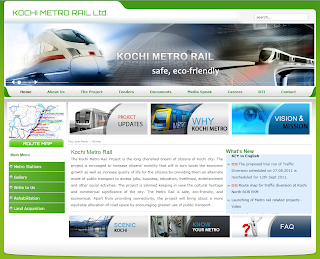
Kochi Metro Rail

The Kochi Metro Rail Project is the long cherished dream of citizens of Kochi city. The project is envisaged to increase citizens’ mobility that will in turn boost the economic growth as well as increase quality of life for the citizens by providing them an alternate mode of public transport to access jobs, business, education, livelihood, entertainment and other social activities. The project is planned keeping in view the cultural heritage and commercial significance of the city. The Metro Rail is safe, eco-friendly, and economical. Apart from providing connectivity, the project will bring about a more equitable allocation of road space by encouraging greater use of public transport.


View Site

Vizhinjam Deep Water International Transship Container Terminal Project

Vizhinjam is a coastal Town in Thiruvananthapuram (Trivandrum) District of Kerala state, South India.Vizhinjam, ‘Port of the Future’ is located at 8021’N and 770 0’ E on the west coast of India and has a number of inherent strength as a port. The Port is merely a 10 NM diversion from international east-west shipping route and is also close to national/regional road and rail network. The sea is 23 to 27 metres deep at the proposed site. This would facilitate berthing of large container ships. As India now did not have ports that deep, goods were being transported on smaller ships to India. The port is supposed to be 150 metres in width.

View Site

Stray dog menace

One of the main problems in Trivandrum is the ‘stray dog menace’ .Do you agree with this?


View Top news
Post your comments :)